Friday, 7 June 2013

Day 31. Saint-Aubin-de-Blaye to Saint-Martin-Lacaussade. 21 kms (726)

Crass Casualty obstructs the sun and rain,
And dicing Time for gladness casts a moan. 


People have often observed that one lives a life in miniature on the Camino, in which everything rushes by very quickly. One meets people, has a meal with them or walks with them for a few days, and then leaves them, people with whom one might have been friends in real life. Experiences are brief, but perhaps more intense.

Yesterday, I had a meal with a cyclist, Sebastian, a policeman, who was going to Santiago. We were the only diners in a huge restaurant, with perhaps 40 tables set up, waiting for customers. A cat bounced across the tables. Perhaps that was why we were alone. 

Sebastian had walked on other chemins in France, but had suffered a serious illness, and was now unable to walk long distances. So he was riding his bike. It would take him about ten days to get to Santiago. It was a memorable meal, and I wish him well.

I left Saint-Aubin just after eight, and headed for Etauliers, the first village, six kilometres on.

Now that I've left the Departement de Charente Maritime for the Gironde, the concrete bornes with their reassuring little piles of stones on top have been replaced by wooden poles with the coquille, and sometimes the painted yellow arrow that guides you in Spain. Unfortunately, the placing of these markers is not always consistent, so I had to open my guide at times.

As I walked along, a tiny rabbit bounded away and disappeared into a hole by the side of the road. Then I saw his brother or sister, squashed flat on the pavement in front of me, victim of "Crass Casualty". Why did one live and the other die? I thought of that great poem, "Hap", by Thomas Hardy. It is hard to accept that our lives are governed by Chance..

If but some vengeful god would call to me
From up the sky, and laugh: "Thou suffering thing,
Know that thy sorrow is my ecstasy,
That thy love's loss is my hate's profiting!"

Then would I bear it, clench myself, and die,
Steeled by the sense of ire unmerited;
Half-eased in that a Powerfuller than I
Had willed and meted me the tears I shed.

But not so. How arrives it joy lies slain,
And why unblooms the best hope ever sown?
--Crass Casualty obstructs the sun and rain,
And dicing Time for gladness casts a moan. . .
These purblind Doomsters had as readily strown
Blisses about my pilgrimage as pain.

After Etauliers, I had a choice: to take a rather circuitous route to visit some pilgrims' graves, or head directly towards my gite along a cycle path which followed the route of an old railway line. I intended no disrespect, but decided to give the pilgrims a miss and take the short cut. 

I was musing on another one of my themes - the enlightened policy in France which spends public money so that the "common people can re-create themselves" - when I noticed a tractor with a huge folding lawnmower attachment coming down the path towards me. It was cutting the long grass on either side of the track. I let him go by, when suddenly he put the great machine into reverse and backed up the trail to catch me up. He had noticed the maple leaf on my backpack, and wanted to chat. He had been twice to Quebec, and travelled all around the province, and wanted to tell me about his experiences. We chatted for fifteen minutes or so. He said he would like to live in Canada. I said I would like to live in France. We agreed that it was good to visit another country and experience a different culture.

It is interesting that there is no distinction made in France between Canada and Quebec. Québécois sont Canadiens.

After that, it was easy walking to my gite at Saint-Martin-Lacaussade. Vines covered every square inch of land: grapes as far as the eye can see, slowly growing for the autumn harvest.

I am three kilometres short of Blaye, where I catch my boat tomorrow to cross the Gironde. After that, it's a long day's walk to Blanquefort on the outskirts of Bordeaux. I have to leave very early in the morning to catch that first boat.

The nearest restaurant is at least a kilometre away, so I've prepared my own meal here at the gite. Pâté, then sausages and lentils from a can, and then cheese, all washed down with a half bottle of Bordeaux.


Thursday, 6 June 2013

Day 30. Saint-Disant le Blois to Saint-Aubin-de-Blaye, 20 kms (705)

Of Man's First Disobedience, and the Fruit
Of that Forbidden Tree, whose mortal taste
Brought Death into the World, and all our woe,
With loss of Eden... Sing Heav'nly Muse

When I arrived at the farm last night there was no one there, so I wandered around. I was puzzled by one large room, sparsely furnished, with two outside doors, both left ajar. I noticed a swallow's nest on the ceiling. Later, I learned that the farmer and his wife leave that room open for a pair of swallows that come back each year. "We must look after the animals," he said. Apparently swallows are disappearing from the area.

I met an interesting Canadian as well, Boris. He and his assistant were repairing the roof of a nearby church. I don't think I have ever heard anyone speak so passionately about his job. He had an interesting background. Born in Montreal, he had worked in construction in Canada and in Louisiana, before moving to France to study for three years with what seemed to been the equivalent of a medieval guild that taught the restoration of historical monuments. His specialization was roofs, and he is now a foreman in a company that is hired by the state to repair historic buildings. He will never be out of a job. 

At the end of a day's work, he said, he can look at what he has done and feel that he has accomplished something. He showed me pictures of some of the roofs he has restored. He will be working on a church in Dax when I pass through, so perhaps I will see him again.

I walked along the highway into Mirambeau against the traffic. A huge truck whipped off my Tilley hat and pulled it along in the slipstream. For a moment I was afraid it would lodge somewhere on top of the truck and be gone forever, but it finally settled in the ditch.

I popped into a bar for a coffee. I was greeted warmly, and one kind gentleman, Jean, wanted to talk about the Camino and insisted on paying for my coffee.

I headed out of town onto the minor country roads. A green tractor rumbled up a hill towards me, belching forth black smoke. I held my breath as long as I could to avoid breathing in the pungent fumes. Then an old lady and her dog waited for me at a gate. She gave me a red rose and some kind of white flowering onion. I promised I would attach them to my pack.

You will have noticed that I tend to harp on certain themes. One of them is the ripple effect of those Wordsworthian "little, nameless unremembered acts of kindness and of love". Another is religion.

I thought again about the piece I had read a couple of days ago.

This piece alluded to the story of Adam and Eve , which has been interpreted as justifying the oppression of women by holding Eve responsible for the introduction of evil into the world.

According to the orthodox interpretation, which Milton follows in Paradise Lost, Man is cast out of paradise because of Adam and Eve's disobedience in eating the apple of the tree of knowledge of good and evil. Message? Obey God, or else! And because it was Eve who instigated it, she bears the blame.

But this is a very strange reading, even for a male priesthood that might want to portray woman as a tempter and reinforce obedience to God, and of course, to God's priests.

First, Adam comes across as such a wimp. "She made me do it," he says. 

Second, Eve appears the stronger character in taking the lead in this pursuit of knowledge of good and evil.

Third, God appears petty and malevolent in punishing man for what he was obviously created to do. Who would want to worship a God who punishes man for exercising his God-given reason?

Fourth, was man expected to live in blissful ignorance forever?

The orthodox interpretation is such a foolish one. How could man be condemned for seeking knowledge? Intellectual inquiry is such an important part of the Jewish and Christian faiths. One of the important aspects of Christianity is the need for man to have the choice between good and evil. Even Milton, that staunch Puritan, insisted that no books should be banned, for the Christian soul must be exposed to evil so that he can make that choice.

Biblical scholars have demonstrated that the Old Testament has been rewritten at least three times, as different waves of priests revised it to reflect their current beliefs and reinforce their authority. Sometimes these revisions didn't completely erase the earlier version, and little inconsistencies remain. If the latest wave of priests had wanted to demonstrate the consequences of doing something bad, for which the punishment would be justified, they shouldn't have left the tree of knowledge of good and evil in the story.

I prefer to see Eve as representing man's intellectual curiosity, insisting on eating the apple of the tree of knowledge of good and evil, because it will "make one wise". And perhaps the serpent who tempts Eve is really a symbol of the Greek principle, Seek Knowledge.

It is strange, though, how the idea persists that ignorance is somehow preferable to knowledge. Perhaps some of you remember some of the sayings we got from our elders. "Curiosity killed the cat" or "What you don't know won't hurt you" or the ungrammatical "Don't ask no questions and you won't get no lies. These belong in the same category as that other classic from a couple of generations ago: "Stop crying, or I'll give you something to cry about!"

My point is, however, that there is nothing sexist in this piece of scripture, just in the interpretation of it by certain men over the ages. In fact, it is a myth which feminists should celebrate, because Woman, not Man, is the superior character. And it's a very important myth, because it reveals the truth that man will seek knowledge for the betterment of mankind and our planet, or our destruction.

Je suis un homme de certain age. That means I have to get up in the night to go to the toilet. Ideally, I will have one in my room, but the facilities in gites are often far from ideal. I am thankful if the loo is on the same floor. However, in some of them the dorm is up top and the toilet down below, accessible only by a narrow, circular staircase. It is even worse when you are in the top bunk. Once I walked ten kilometres to avoid the top bunk. Tonight, at this chambre d'hôtes, the toilet is on the other side of a large house, four doors, two rooms and one corridor away. I will try not to drink too much wine tonight.

Day 29. Pons to Saint-Disant du Bois. 31 kms (685)

Salvete et Valete

I left the gite before eight, walked under the arch of the pilgrims' hospital, along the road, and back out onto the fields. Corn and beans, now, along with the cereal crops. And vines on the higher slopes, quite advanced, with tiny grapes forming on the stems.

A hare bounded along between the rows at the speed of light. Aesop made the right choice.

My Italian friend has gone. He has a job at Bordeaux, and had to take a train to get there in time. I would have placed him as a student, or an impecunious fellow in between jobs, but no, he is a freelance photo-journalist, who abandoned a PhD in engineering to follow his passion. He was telling me about a recent story he was doing in a Muslim country on the plight of homosexuals. I won't go into detail in case the secret police are reading this.

I wonder if the use of certain loaded words triggers off spy monitors. Perhaps I can increase my readership.

That makes three pilgrims I have met and then parted from.

I came down from the fields to the town of Saint-Genis-de-Saintonge where I had a pleasant surprise. A bar where I could have the coffee I had missed out on at breakfast! While I was there, I happened to notice a question in a quiz on the TV.  What are the three most ecologically minded countries in the world? You have a go. I'll give you the answer later. 

Sitting across from me was a fellow who sounded familiar. I've heard that voice before, I thought. It was Greengrass speaking French. But there were no other Gallic cousins of the characters in Heartbeat. He didn't look like Greengrass. Nor did he blink with both eyes. But he spoke in fits and starts, and I would have recognized that voice anywhere.

Again, the barman spoke a little English to make me feel welcome. Of course, he had friends and family in Canada.
 
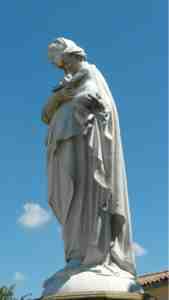
Don't be alarmed by the statue of the Virgin. I didn't pass through Syria this morning. Across the street from the bar, I noticed that the statue had been presented to the villagers by the heirs of the Marquis de Dampierre, who had inhabited a nearby chateau. I speculated. Had he been a cruel tyrant? Had he lost his head to the guillotine? Were his heirs now making amends? Or had the Marquis been a kind master and his heirs were now continuing that kindness? Either way, it seemed a fitting conclusion to a story from the past.

Something happened at lunch today. In the morning, I was a little agitated, counting the kilometres, conscious of how far I had to go, but in the afternoon, I was relaxed and walked with a steady rhythm, unconcerned about my progress. I could have walked on forever. Was it the kind words of the barman? Was it the coffee? Was it the Virgin?

After my little excursion into religious matters a couple of days ago, a friend wrote that for someone who was not a believer, I could have fooled her. But no, I am not a believer.

I had a rather lonely childhood. But a friend dragged me along to his church, and I was made to feel welcome there, and was never indoctrinated in any way. It was a good experience. So I retain a certain fondness for it.

But mainstream Protestantism was never incompatible with reason. After all, if God gave man a mind, he was expected to use it. I used it, and so did the theologians whom I read, and we agreed that the virgin birth, the divinity of Christ, and the Resurrection were in fact attributions to an ordinary man by the early Church. Those fundamental tenets of Christianity just didn't stand up to reason and research, and without them there is not much left. Ironically, and sadly, those mainstream denominations where one was allowed to think are now in decline, whereas other leave-reason-at-the-door, just-make-a-leap-of-faith groups are experiencing a huge growth. 

So I am not a believer, but I still find the subject of religion more interesting than almost any other. Tomorrow, I may return to my thoughts on the anti-religion diatribe. You may want to give it a miss.

On my way to the gite I was impressed by the rugged little church of Saint-Disant. No silver candlesticks there. I guessed that the church reflected the solid, no-nonsense, humble, hard-working farming community around it.

I am staying tonight at a farm. Delightful! Chooks are clucking around outside, and inside as well where a door has been left open. A rooster is on patrol, crowing every so often to show who's boss. Cats roam around, and a young puppy, in love with life, frolics about. A donkey watches me from a nearby field. Once in a while he makes a noise like a train sounding its horn at a level crossing. And then he rolls on his back in the sun like a dog. He is rather timid, but his mate, a small horse, is more friendly. I go over and pat him carefully, he and I both wary of the electric fence between us.

And now the answer to the quiz. 1. Iceland. 2. Finland. 3. Norway. And Canada? 249th. Probably!


Tuesday, 4 June 2013

Day 28. Saintes to Pons. 23 kms (654)

No man is an island, entire of itself

Yes, the chorus of snorers continued into the night. But then they stopped; for later, all was silent.

Curiously, snoring seems to be contagious. You never hear just one snorer, but always several, as if one has triggered off the others who then want to compete with the first. Perhaps there are mischievous incubi and succubi which enter the nasal orifices of the sleepers and possess them, causing them to manifest this unnatural behaviour which they later deny.

It was chockers last night with not only six of us in one small gite, but four bikes as well. Tonight at Pons I am sharing a large gite with the young Italian pilgrim. The gite is attached to, but not actually in, a medieval Hopital de Pelerins.

After I left town, I walked along the river for a while, then up a grassy lane, along the highway past an airforce base, and then across the fields for miles. No vines at first, just cereal crops. The sun was shining, the breeze was blowing, the birds were singing.

Oh, what a lovely walk!

And then later, on the higher slopes, the grapes. I was taking a short cut through some vines, and a car stopped ahead of me, at the point where I was to leave the vineyard. Was I going to get into trubs? No, it  was a former pilgrim who had done the Camino last year and wanted to chat. He put me onto a good spot to stay tomorrow night.

You can see from the photo at what time I left Saintes this morning. Imagine having that cathedral spire look over you wherever you are in the town! 

I am convinced that even in this secular age it has an effect on the soul of the inhabitants. Consciously or unconsciously, as they look up at the tower and across at the Roman arch, they must feel a part of history. This afternoon, as I had a beer at a bar overlooking a medieval donjon in Pons, and watched a teacher leading a troop of tiny little kids around it, I thought the same thing: they must absorb history through their very pores.

Thus, without realizing it perhaps, they find their place in the vertical scheme of things. And in the horizontal scheme of things as well, as they encounter so many people from different countries passing through their towns. I find that more and more people in the towns I pass through speak English to me in an effort to be friendly and welcoming. Europeans have a sense of their community and their place among their sister nations.

I eat dinner on a patio overlooking the hotel de ville and the massive donjon. Rooks circle around the tower and seem to cling to the vertical walls as they find their nests within. Swallows swoop overhead. Raucous lads drink their beer down below.


Monday, 3 June 2013

Day 27. Saint-Hilaire-de-Villefranche to Saintes. 25 kms

Let us gather at the river

I spent a very comfortable night at the gite. I was alone in this huge establishment, a former farm, capable of holding 30 people at a pinch. No likelihood of being turned away there. He was a former viticulteur, a producer of wine, and he had evidently done a fair bit of sampling in his time. He had a florid complexion, and tossed back his aperitif with a flourish. She was garrulous, talking non-stop about the excessive demands of her aged parent. But after giving me a reasonable meal with wine and aperitif, and doing my washing, and giving me a comfortable bed, all they expected was a donation. Some impecunious pilgrims would have given them only five Euros, but I gave them a fair amount.

As I walked out of town, I passed one of those massive railway stations, of grander proportions than one would expect in a little village. The railway, too, was an institution that believed "by your works, ye shall be known", and took pride in its architecture. Once this station would have housed a station master, his family, and perhaps a ticket collector. Now it probably had an automatic ticket dispenser.

I am now passing through the region of cognac and pineau, and the signs for these delightful products are everywhere. I learned last night that cognac is distilled from white wine that is not suitable for drinking.

I quickly walked the few kilometres along the highway to join the Chemin at Juicq. Then it was down a limestone road to a narrow hollow trail through the woods which may have been the old pilgrim route. It had an air of antiquity about it. After that it was up and down, and in and out of woods.

This route is getting better and better, as we spend less time on the bitumen, and more and more on minor limestone tracks or in the woods. For the most part, the Chemin de Saint-Jacques, marked by its concrete bornes, follows the GR, but from time to time the latter wanders off on its own. A few days ago, I was walking along a road, and the GR took off around a square field to join me a little later. I had walked along one side of a square; the GR had followed the other three.

As I approached Saintes, the trail became quite hilly, and I thought it would have been a real killer for those people who were walking from Saint-Jean to Saintes in one step.

Situated on both sides of the River Charente, Saintes is a delightful town. Hosting 16 churches and associated hospices in the Middle Ages, it was an important pilgrim assembly place. They would enter the town and cross the Charente by an old Roman bridge, of which only the Arc de Germanicus remains. To me it looks a little out of place, standing alone on the bank of the river. The spire of the cathedral dominates the town. The most remarkable feature is the ruins of a Gallo-Roman amphitheatre, which unfortunately was closed when I went to visit it.

I am staying in a refuge attached to the Eglise Saint-Eutrope, a church with a mighty spire and a huge crypt. There are six of us occupying three double bunks: three Spanish cyclists, one English cyclist, an Italian foot-pilgrim and I.

As I type these last lines before I go to sleep, I feel that I'm back in Spain. The Spaniards are snoring, one rumbling bass, a baritone, and a tenor.


Sunday, 2 June 2013

Day 26. Saint-Jean-d'Angely to Saint-Hilaire-de-Villefranche. 22 kms (631)

Men may construe things after their fashion,
Clean from the purpose of the things themselves

Yesterday, I plodded. Today, I ambled. Tomorrow, I will stride.

Tomorrow, I will leave early and hurry to Saintes, hoping to arrive by midday, leaving time to visit the town in the afternoon, for there is much to see. Today, I ambled, for I was splitting a long step in two. I was in no hurry and enjoyed the pleasures of the walk.

As I walked out of town, I crossed over several little streams which were separated from the main river I was soon to cross. On either side, houses backed up against the stream, jutting over, having easy access in the past to drinking water and probably sewage disposal. 

With the warmth of the sun on my back, I reached the open countryside. Wind turbines turned lazily on the horizon and a hawk circled overhead.

Later in the morning, I saw a flying scarecrow at close quarters. This one, anyway, worked only in the wind, lifting off the ground at the slightest breeze.

I walked across fields, along brooks, and through woods, coming out of the wilderness every so often to pass through a little village or hamlet. The first sign of life is always the church spire pointing up to heaven, and to me it is a symbol of life, of past faith, but also of community and civilization. The Church, for all the malpractices of its members, must also be credited for keeping knowledge alive during the Dark Ages; and man's intellectual, artistic, and even scientific, exploration have evolved out of Christianity.

These thoughts led me to reflect, for I had lots of time for reflection, on a piece I had read this morning, holding religion responsible for the oppression of women.

It is not uncommon for critics to hold religion responsible for all the evils of the world, from the supression of women to the subjugation of other human beings of a different race or creed. In fact, it is not religion, but the men who have practised it, exploited it, and interpreted it after their own fashion, who must be held to blame. Their self-interested practices evolved into that institution which in Western Civilization became known as the Church. Vitriol should perhaps be directed at the Church, not religion. 

But indeed, those same members of the patriarchal society dominated other institutions as well, shaping them to justify their actions and affirm their superior position in society. Secular society of the past oppressed women in all its institutions.

Religion is a set of beliefs and actions practised by a group of people. Today, in the mainstream Protestant denominations, women are equal, even dominant. Many of these congregations have turned themselves into food banks, getting back to original teachings and exercising Christian charity. 

Heavy with dogma, the Catholic Church has found it more difficult to reform. Yet it no longer prays for the conversion of the Jews, or preaches hellfire and damnation. Limbo has slipped into oblivion. Purgatory cannot be far behind. That nineteenth century accretion, the infallibility of the Pope will soon be on the way out. I'm sure that Pope Francis doesn't believe that he is infallible. Contraception is permissible under certain circumstances. Married priests are already accepted into the clergy if they arrive from outside, and the whole unnatural practice of celibacy has fallen into such disrepute that it must surely be abandoned in time. Especially if the Church hopes to recruit priests. 

That is the institution. In the meantime many Catholics, I am sure, are practising a religion which holds men and women as equals, and are themselves working for change in the Church itself.

It is not Christianity that is responsible for the oppression of women. As far as I know, there is nothing in the teachings of Jesus that discriminates against women or any other group. As I recall, he argued that all could be distilled into

Love thy God, and
Love thy neighbour as thyself.

To rail against religion is unfair to those who live by these principles.


Saturday, 1 June 2013

Day 25. Aulnay to Saint-Jean-d'Angely. 25 kms (609)

The ploughman homeward plods his weary way.

After yesterday's marathon effort, I was sluggish today. No grand events to report! I didn't lose my phone and I didn't lose my way. It would have been difficult to get lost in the Departement de Charente-Maitime, where we are now walking. Big concrete blocks embedded in the ground and displaying the coquille indicate any change of direction.

After breakfast, I visited the Eglise Romane Saint-Pierre-de-la-Tour. Outside, some of the carvings are eroded, but there is an interesting statue of St. Peter crucified upside down. Inside, the carvings on the capitals of the columns are well preserved and quite magnificent. Sorry if you are thinking "another bloody church".

As I walked out of town, I passed la Rue Sans Soleil. That was a bad sign.

Later I passed a farmer making hay. That was a good sign.

I walked at a leisurely pace across the high plains through fields of oats, wheat and barley. The sun came out and I enjoyed the beauty of it all. The brilliant red poppies along the edge of the fields stood out against the yellow background of the canola flowers. In the trees I could hear the song birds, and above the fields, the larks. A harmony of colour and sound! I miss the maggies and the gum trees, and I like walking in the Canadian forest, but nothing matches the beauty of the European countryside. 

I also met a couple of friendly dogs and saw sundry farmyard animals.

Just before Saint-Jean I passed a very plump lady cutting some very long grass in a very large yard. In the centre of the yard stood her husband dressed in a pink shirt and red velvet pants. Why was he just watching her, I thought. Why wasn't he helping, the lazy bugger? He didn't move. He was a scarecrow.

I am staying tonight at the European Culture Centre which is housed in an old abbey. I am sharing a room with Frank the Parisian and another pilgrim who has just arrived from Brittany. They will leave me behind tomorrow.

Normally, I would be walking 35 kms tomorrow to Saintes,  but I have decided to break this step in two. The Office de Tourisme has reserved a place for me on a farm halfway. 

I have written enthusiastically before about the Offices de Tourisme. Since then, I have found one or two who were less than helpful, but in general, they have offered to book ahead for me. I will telephone  if I have to, but sometimes I get someone at the other end whom I can't understand, and I don't know what I'm agreeing to. So I always accept their kind offer.