Saturday, 27 May 2023

5. Casa de Fernanda to Labruja. 25 kms


Thomas, the hospitalero at the albergue two nights ago had recommended the Casa de Fernanda (a few kms before Vitorino dos Piães) where I stayed last night. It was remarkable. 


We all slept in a bunkhouse separate from the family home. Beds with sheets, good shower.


Martin, a loud-voiced Dutchman and former security officer in a mental hospital, and on his sixth visit to the albergue, was playing the role of host when I arrived, plying us with wine and making sure that we knew each other. At one stage when he was making us go around a circle reciting everybody’s name from memory, I thought it prudent to disappear, but perhaps I should’ve stayed and practised in preparation for the big marbles test.


The evening meal was superb. We selected from a variety of dishes: sardines, which I declined, pork, rice, and various chick pea and bean plates.


(Sardines. Now that’s a Proustian moment. I recall the cans and feel the metal  pressing into my finger as I twist the handle to open the can. And the taste, not of the fish  themselves, but the heavy oil they were swimming in.)


After dinner, the host produced bottles of port and firewater, to prepare us for the singalong.


“Charles,” shouted Martin, from the other end of the table, as if I were one of his patients. “You sing.” I was ready to sing Waltzing Matilda, as I’ve had to do in the past when pilgrims were invited to sing a song from their own country, but fortunately, I held back, for it wasn’t that kind of singsong at all. There was actually a song book, but we certainly weren’t all singing from the same one, not the same tune, anyway.


The first song was one I realized I should have known, because everyone else did. “California Hotel”. It didn’t seem to have a tune, or not the way we sang it. And then we sang some Beatles songs, which I knew, of course, but it was difficult to know what key to sing them in. One fellow sang in a particular strident monotone with great enthusiasm. Sometimes Fernanda our hostess joined in with a voice like a wailing banshee. And you can imagine the cacophony when we sang “Hey Jude”. I made my excuses and retired early.


Breakfast was very good as well, with yoghurt, bread, cheese and sausage, and excellent coffee.


All of this for 25€. A couple of fellows who left early, gave me their money to pass on to the host. When I paid, he simply took the money without checking us of his list. I was moved by the trust we all had in each other.


It was a long day with some delightful moments and a serious climb.


As I entered the village of Vitorino dos Piães the clock in the church tower was striking nine very loudly, making sure that everyone was awake, first  the quarters, then the hours, and then, in case someone had been woken up but not caught the time, it struck the hours again.  Very sensible, that. After that, and a short, steep climb, I was hoping for a café at the top of the hill. But there wasn’t one. I chatted with an Aussie from Newcastle instead.


A short stretch of highway and then off to the left, and an absolutely delightful walk along an old road, down and around the side of the valley, with lots of eucalyptus, of course, with its scent in the air, and broome and foxglove, and chirping birds, marred only by the snarl of a chainsaw in the woods, and the the sound and the fury of a two-stroke motorbike racing towards me, the curse of the Camino. As I ended the walk through the valley and entered the outskirts of Seara, I noticed an interesting statue of St. James in the wall. Rather aloof, I thought.


I shall refrain from returning to the theme of why I walk, but I was filled with euphoria as I strolled down this valley in the cool of the morning.


Ponte de Lima is a seaside resort on the river, the promenade lined with grand hotels and other magnificent buildings. You walk into town along an avenue of plane trees and approach the long, low, medieval stone bridge which has given the town its name. I will cross that bridge when I come to it, I thought.


The medieval bridge at Ponte de Lima

I did, and I stopped for a small beer at a bar on the other side. Not a wise decision, for it was harder going afterwards.


I walked along the bank of the river, and came to another cobbled road. A woman was repositioning a stone, which, she said had been dislodged by a tractor. She confirmed that all the stones across Portugal had been laid by hand, originally just in sand but sometimes now in cement. They were historic and were being preserved.


I continued on past olive and walnut groves, and more and more grapevines. One farmer was spraying his vines, with a heavy, evil fog of pesticide. I hurried by.


In Vino Veritas


One day a fog came down upon the vine

And caught the budding insects in their prime.

While we, quite unaware, consume our wine

And stunted trees bear witness to the crime.


It was a bit of a bugger of a climb at the end, only 500-600 feet from bottom to top, but more than that because it was a series of ups and downs.


Finally, at 4:30 I reached Albergue O Conforto, which is not very comfortable and certainly not very hospitable. I have just eaten the worst dinner of my Camino life. But I’m the only person in a two-double-bunk room.


(Sorry about the formatting in this post. Blogger is driving me crazy)

Friday, 26 May 2023

4. Barcelos to Casa de Fernanda. 20 kms


Unconcerned

Ignorance is bliss, or so they say.

Thou liest, happily, upon the Way.

Upon the Way, but in the way as well,

Whether thou survivest, time will tell.


Ignorance, confidence, optimism or fatalism: there he lay in the middle of the road, oblivious to his peril. Perhaps there was a moral here.


It was a glorious day. I am somewhat rested and relaxed, and I notice as I look at my watch while walking that my pulse rate is 20 or 30 beats a minute less than it was a couple of days ago. To return to that rhetorical question, one of the reasons I keep walking is to get fit. (I am tempted to reflect on what sedentary beings we have become and how we are evolving into easy prey for AI.)


I followed a string of pilgrims out of town along a wide, leafy boulevard. Doves were a-cooing, “doo-doo, doot; doo-doo, doot,” but one with a variation, “doodle-y-doo, doot; doodle-y-doo doot.” Did she just lay an egg? 


As I arrived at a railway line and started walking along, I saw a pilgrim coming towards me along the lane on the other side of the line. I pointed at the arrow in front of me to indicate she was going the wrong way. “No,” she shouted, pointing. “I crossed underneath 500 metres down there.” No train was coming so I hopped over the line.


I headed out towards distant hills through a deep cutting with eucalyptus trees above me on either side. Once again I was walking on a cobbled road. I marvel at their construction. Every individual stone must have been laid by hand. By now, I have walked across billions of these stones and only one have I seen uprooted.


In the distance was a cafe with people sitting outside. A sight for sore pilgrims! I joined Marie the Glaswegian and a German couple whom I had met last night at dinner. Anyone who has walked the Camino will tell you that one of its pleasures is arriving at a cafe and recognizing familiar faces. A couple of Portuguese girls appeared. One said “Hi” several times. “That’s the only word in English,” she knows, said her friend. “Obrigado,” I responded.


I came to a junction and faced a choice: 186 kms to Santiago via the church or 186 kms to Santiago via the wooden cross. I chose the latter, hoping to see an old rugged  cross on a hill far away, but no, it was an unattractive one under a tiled awning in the next village, dated 1926. As I sat on the bench the Portuguese girls arrived. “Hi,” said one of them.


On to the main road, over the crest of a hill, and along a path behind a road barrier, more treacherous than the road itself, so I hopped back on to the pavement. This is not a pedestrian-friendly camino!


And then the highlight of the day, the crossing of a magnificent stone bridge. “Ponto Romano?” I asked a nearby farmer in what I hoped passed for Portuguese. “Si,” he said. But it wasn’t. It was the medieval Ponte das Tábuas, the bridge of boards, a reference to an earlier wooden bridge, according to Brierley. I walked across the massive stone slabs and on to a dirt road, unremarkable but for the rugged stone markers on either side. This was a very old road indeed, and I was not the first to travel there.


At the next town, I resisted the invitation to visit the site of the first Marian apparition in Portugal (1702), and pressed on towards ominous thunder clouds. I thought of the nun on the Chemin de Tours who was horrified when I declined to visit le Christ qui sourit.


About a kilometre before my destination it started to rain. Fortunately, a German couple ahead of me had just rummaged around in their packs and donned their rain gear, so it stopped. I thanked them. I arrived at the Casa de Fernanda.

Thursday, 25 May 2023

3. Saō Pedro de Rates to Barcelos. 16 kms

Everywhere I look as I walk: in every direction, on the hills and between the fields, I see stretches of Aussie gum trees.

It is truly remarkable how the Australian eucalypt has colonized the Iberian peninsula.


Even in what remains of European woods, the gum tree is springing up among the native oaks, strangling what remains of the indigenous species. These foreign invaders were not uninvited colonists, of course. Apparently they were thought to provide good timber for the making of furniture. Or so I was told.


The most pleasant moment of the day was a little detour off the road and through one of these Eucalyptus forests. You will see from the stones that mark the border, that this was likely a very old road that would have run through a European wood of oak or beech or ash before the mid-nineteenth century. Now, it’s a forest of tall, thin, dull eucalypts.

After a lousy sleep due to jet lag and a warm dorm, I walked slowly and carefully today. I’m falling a little behind my schedule.


 I’m installed at the Albergue at Barcelos which is less comfortable than last night’s. One dorm, a dozen beds, one set of three showers, two working, for men and women  alike, supplied by a hot water tank on the other side of town. Just when I had given up, and was bracing myself for a cold shower, it spurted out, scalding hot.


The town is nice with quaint streets and little plazas, but not on a grand Spanish scale.

Wednesday, 24 May 2023

2. Mosteiró to Saō Pedro de Rates. 19 kms.


 “A man’s a man for a’ that”


The Camino really does provide, as I’ll explain, but first, here’s a little background. I was passing Beaver Lake on the way to the airport when I realized I had left my hiking poles behind. Because I was early, I returned home to pick them up. They were compressed, bound up with tape, and I had no trouble getting them through security. At Porto Airport I cut the tape, unscrewed the sections, extended the poles, and tried to tighten them again. To no avail. The devices had jammed and I had to throw the poles away. I hoped to find a new pair along the way. When I asked Isabella, our hostess, if there was a gear store in the vicinity, she said no, and gave me a pair she wasn’t using. So I’m clacking on to Santiago.


My pack was heavier this morning, even though I had lightened it by taking out my heavy boots and replacing them with the light loafers I wore yesterday. And I left some dirty underwear behind as well. I wasn’t really with it, yesterday. Am I ever?


We continued along cobbled lanes. Not rounded English cobbles but small square stones that seem to be standard on the minor roads. I was glad of my boots, for these stones would be very uncomfortable in lighter shoes. Heavy traffic shared these lanes as well and squeezed us up against the stone walls as they passed. Occasionally there were sidewalks, but these were often only a couple of feet wide. I can think of no other city on the Camino more difficult to exit on foot.


You will notice the plural pronoun. For some of the day, I was walking  a Scottish lady, a little difficult to understand with my poor hearing. She comes from Burns country, and we exchanged a line or two. We also discussed our favourite Scottish novelists — Ian Rankin, Val McDermid and Peter May. She recommended the Shetland novels on which the TV series is based.


And then I was overtaken by a couple of tourist pilgrims, Germans, who asked if they could walk with me. They soon regretted their decision when they realized how slow I was. They made their excuses, and raced ahead to catch their bus at the next village.


It was a warm day, 21 degrees when we set out, rising to 24 by the end of our day, but eased by a cooling breeze at the tops of hills. The best things in life really are free, but not the ice cold beer the I enjoyed when we reached Saõ Pedro de Rates.


I am staying at the municipal albergue, managed by Thomas from Wisconsin, a very jovial fellow with whom it was safe to discuss politics. There was trouble, though, when I registered. He seemed to think I was using some older fellow’s passport. Of course, he had to query my date of birth in the presence of other pilgrims, so once again I am an Aged Curiosity.


The facilities here are basic, with “leaner” showers with a tap that you press for a ten-second spray and a loo far enough away to wake me up when I visit during the night.


On one section today, a sign told me that I was walking on a Route of Roman Bridges. There is one of them above.


Tuesday, 23 May 2023

Camino Portugués. Porto Airport to Mosteiró. 6 kms

For this elderly pilgrim from Porto,

It was further to go than he thought—o,

With an excess of will

He trudged up a hill,

And wished that he’d taken an auto.


The airport at Porto is north of the city, close to a point halfway along the first stage of the camino. So I walked five or six kms to join the camino at Mosteiró, where I’m staying at the Casa dos Caminhos. But it was tough going with no sleep the night before.


I picked up a Sim card at the airport for $35. It seemed a bit steep, but I got 10 gigs of data, and 1,000 local and 100 international minutes,  so perhaps it wasn’t such a bad deal.


Then I set off to find the hostel with my GPS. The latter was a bit confused at first, and tried to lead me onto the runway, but I dodged the planes and headed north along cobbled lanes, rows of houses on one side, and high stone walls on the other, protecting grape vines. And then intermittent fields of corn and the odd vegetable garden. It was more pleasant than it had looked from the air — a massive agglomeration of development with occasional green patches — and was definitely semi-rural. I remembered that as I had come in to land seven years ago, I had looked over the same area, stretching out to the sea, and decided to take the coastal route.


Speaking of which, I noticed that some of my route this afternoon was marked as the Portuguese Coastal Camino, but it wasn’t the path I had taken then. Why would you walk along the east side of the runway, when instead, you could trot down to the river from the cathedral, walk along the bank to the coast, and then tramp along the boardwalk by the sea?


And to quote another rhetorical question, I remember someone saying at breakfast, somewhere on the Camino years ago as we discussed where we had walked before, “How many caminos do you have to walk? You must be wondering the same thing. Well, this is the last one.  But then I said that ten years ago.


I have been seeing those metamorphic gum trees again, eucalyptus which begin with fat baby blue-green leaves that mature to quite different long green-brown ones.

Tuesday, 18 October 2022

Santiago de Compostela


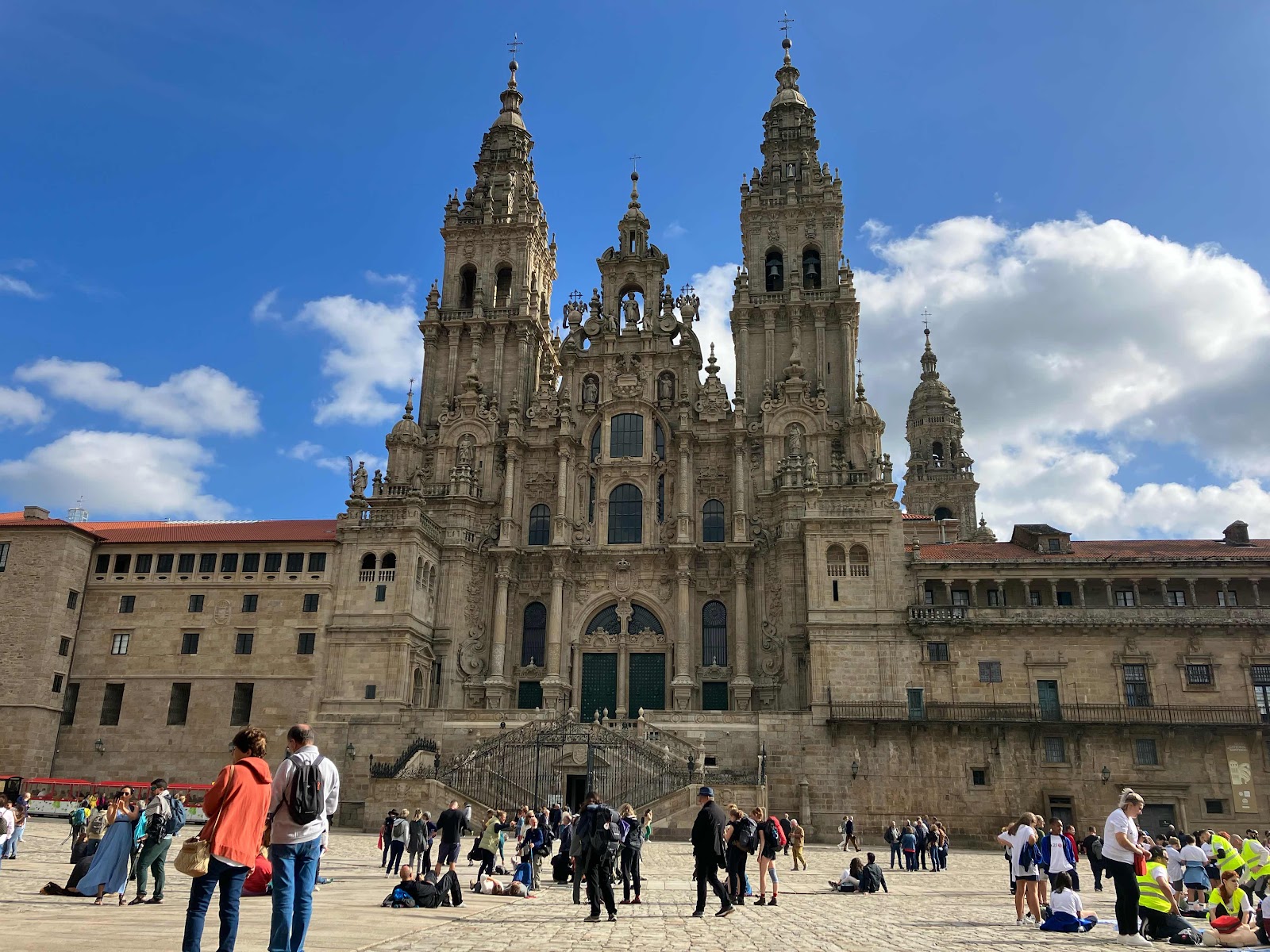
Once again I wander up to the cathedral. The Galician pipes are still wailing as I walk through the tunnel. The little red train with its string of toy carriages makes its routine incursion into  the Praza del Obradoiro, but there are no silver-painted Saint Jameses or attendant angels trying to stay motionless in the wind. The  place is alive with pilgrims, cameras out, recording the momentous arrival, some with selfie sticks, others having their photos taken by fellow pilgrims or obliging bystanders like me. One large group, twenty or more, pose in front, and the same photo is taken by twenty cameras in turn. Pilgrims sit with their backs against the columns of the government buildings to the west, gazing at the cathedral. Others lie flat on their back on the paved stones of the square.


Some stand, some sit, some crouch, some carry one another. Some people assume the most unusual poses. One fellow lies prone, while his mate takes a photo from foot level. A colourful lady in purple dances for a video. A couple rest their camera against a hand bag and scramble to get in position, crouched with thumbs up for the timed photo. The cathedral is always patiently behind. I suspect it features in the background of more photos than anywhere else in Christendom.


On one side of the square a party of school children are being taught CPR by a steam of first responders. They pump away at the dummies on the ground. Seems appropriate, for this is a place of respiration and revival. In the corner of the square is a van with a few armed police standing by.


It’s the range of pilgrims that is so astonishing: the occasional single old man or woman, older couples, young couples, pairs of men or women, family groups, a mother with her young daughter, lots of young people, and not today, but perhaps yesterday or tomorrow, the Swedish and the Spanish couple with their baby. I see some dogs that may have walked the Camino as well. 


This is the scene every day of the year.


I visited the Pilgrim’s Office today to get my compostela. It’s a slick operation now, and technological, in an effort to keep up with the increasing number of pilgrims arriving each day. I spent more time outside the office than in, trying to work out how to scan the code that was supposed to simplify the process, until an official took pity on me and allowed me to fill in my details on an old fashioned piece of paper. I was given a number and I had to wait until it flashed on a screen: 168 Mesa 13. The lady at Table 13 scrutinized my credential very carefully, asked me about missing dates, and then gave me my compostela, made out to Carolum , accusative case in keeping with the text. I’ve always wondered whether they would have a go at my surname, to wit, Carolum Moodium, or perhaps, as my Latin teacher sometimes referred to me, as  Carolum Saturninum. What do they do with Christian names that don’t have a Latin equivalent?


This time I had lunch at the Restaurant Garigolo, for 12€, better value much further from the cathedral. Quiet ambience with Pachebel-Canon-type music in the background. The lentil soup was excellent, and the curried chicken, like the restaurant,  left a good taste in my mouth.


A few final comments.


First, an insightful and incisive reader has pointed out that my use of the word “inflammable” when referring to “inflammable eucalypts”may have confused some people. To those of my generation, “inflammable” was the only word we had to describe something that would easily burst into flames.  More recently, because the Latin prefix “in” also means “not”, benign language authorities have encouraged the use of the word “flammable” instead, lest someone think it safe throw an inflammable substance on the fire. But both words are current.


And a couple of parting comments about having a beer at a bar in Spain. First it’s wonderfully cold, for the barman serves it in a frosty glass from the freezer. Second, it’s always served with little tapas, which may sometimes constitute a small meal. I have just foregone supper, because my beer came with a small bowl of potato chips, seven or eight olives, and a chunk of tortilla. How civilized!


My parting words of advice? The Invierno is a demanding but rewarding camino of great natural beauty for someone who wants to escape the madding crowd. And If this were my first camino, knowing what I know now, I would walk the Camino Frances, but leave as early as possible in April, or later, in October. 

Monday, 17 October 2022

Camino Invierno: 12. Outeiro to Santiago de Compostela. 16 kms.


Sluggisher and sluggisher


Well, here I am at Santiago. No fanfare for my arrival, though. Just the wailing of Galician pipes. I don’t know whether it’s because I’m at the end, or whether my body’s worn out, but I couldn’t go any further.


I had no choice but to leave early from the regimented municipal albergue at Outeiro. At eight o’clock all the lights went out, even though it was still dark outside. I had wondered why I couldn’t find the light switches. Everything was automatic and timed. Last night at ten o’clock, the lights in the dorm went out, and at seven o’clock in the morning they came on again, but then at eight, everything went out.


It would have been an easy day, but I was sluggish. In fact, when I walked the same stretch five years ago, I fair bounded along. Not this time. It was up and down over slight hills and valleys, keeping on minor roads, and eventually passing through hamlets which have now been swallowed up by the city. In fact, the Way takes you to within a couple of kilometres of the city before it leaves you on a city street, and there is the cathedral on the horizon.


I passed by the cathedral, but will spend more time there tomorrow. For lunch I had the menu del dia at Cafe de Ripoffeiro close by. Caldo Gallego with a few beans, potatoes and spidery kale swimming in a thin broth, watery roast beef, and soggy flan. All for 17€. A few days earlier, at the Hostal where I was staying, I’d had a magnificent caldo, thick with the appropriate ingredients.


I ventured down for a coffee at the familiar grand assembly of tables on the pavement opposite Alameda Park. Further from the cathedral was better value for money. Crows and pigeons scrambled below and fluttered above the tables looking for crumbs. A pigeon landed on my table, his eye on the cellophaned cake that came with my coffee. He wouldn’t be shoed away.


I’m staying at the Hotel Fonte de San Roque, with a nice view, not of the spires of the cathedral, but the twin stovepipes on the roof across the street. I rather like these cheaper hotels in the old towns. They have poky little odd-shaped rooms (in fact this one is trapezoid), because they’ve been forced into old buildings. They are essentially clean but with rusty patches and eroding plaster in the bathrooms. There is no bath, but a shower closet with those sliding or folding doors that may or may not close. If you’re lucky, the shower is fitted on its fixture and directs the water at you and not the wall behind you. The toilet is squashed into whatever space remains in the bathroom. But you get what you pay for.